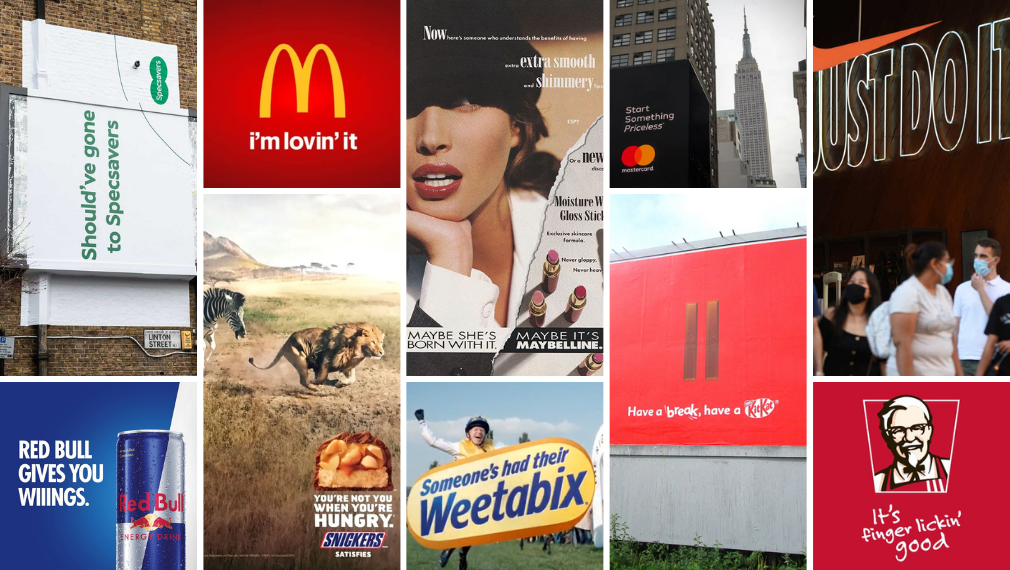
Taglines are often held up as one of the best examples of Distinctive Brand Assets. The likes of “Just Do It” and “I’m Lovin’ It” are iconic examples where the brand owner instantly comes to mind. Nike and McDonald’s have been consistent in their use over a long period of time, backing them with big media budgets. But we generally see a significant disparity in performance between the good, and the not so good when it comes to distinctiveness performance. When well-crafted, taglines can be powerful tools for building a distinctive brand. We sought to explore whether there were specific factors behind their success—insights that could be applied when developing a new tagline.
To achieve this, we conducted a meta-analysis of over 500 taglines from our database, which have been tested in recent years across multiple categories and markets. We reviewed them based on different factors (e.g. length in words, time in market, use as or not as a jingle) and coded them up. We then examined the differences in BAT score, which is our aggregate score comprising of Asset Recognition plus Brand Attribution minus Misattribution.
It's worth noting before we jump into the data, that we are critiquing performance here based on distinctiveness. Many taglines play a more significant role in the differentiation camp, i.e., communicating a specific meaning that may be related to the latest positioning objective or brand challenge. And this is fine. Not every tagline, and not every asset/code needs to play a distinctiveness role.
Firstly, we looked at the length of the taglines in terms of words, to see if that had an influence. We may have presumed shorter taglines would have indexed higher; however, we saw this trend the other way, with small uplifts in scores as the number of words increased. There is often an ask to be as punchy as possible in nearly any walk of life, including advertising; however, this doesn’t play out in the data here. This would suggest that those extra few words might help tell a bit more of a “story”, versus punchier taglines (e.g. Eat Fresh, King of Beers) perhaps helping them have a few additional layers aiding memory storage and recall. Like any of the findings in this analysis, this isn’t to suggest we recommend adding words for the sake of it, more so that if you do land on something you feel has potential, don’t over-edit, or rule it out simply because it’s that bit longer.

Any time you can get your brand name in there, it will contribute incrementally to distinctiveness. This appears to play out within taglines that include the brand name. Repetition of the brand name within the tagline brings an advantage in driving distinctiveness, helping embed it within memory structures. Aside from helping improve the chances of the tagline sticking, having the brand name mentioned just further aids brand linkage to advertising.
Note: Needless to say, the actual version tested did not include the brand name.

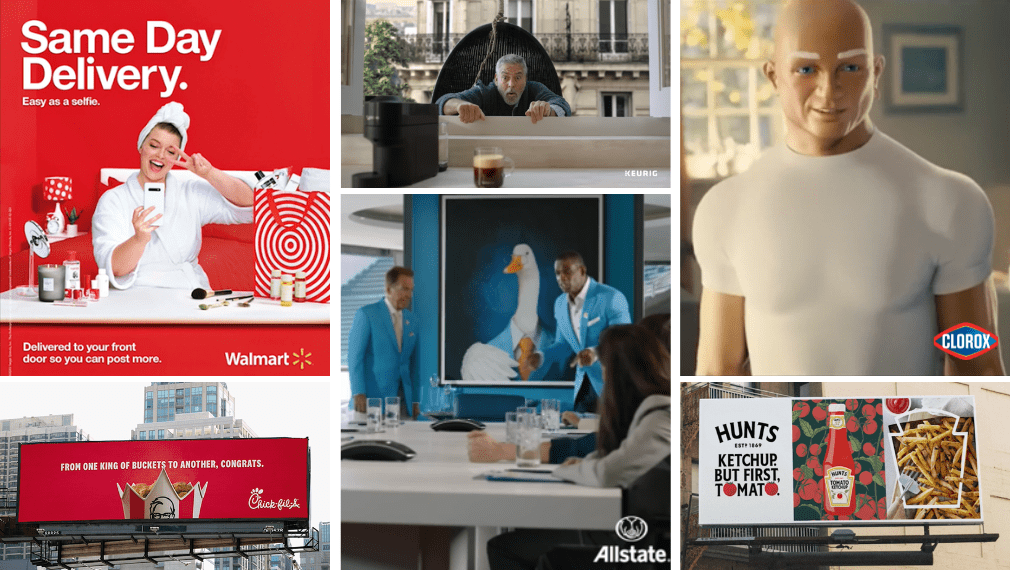
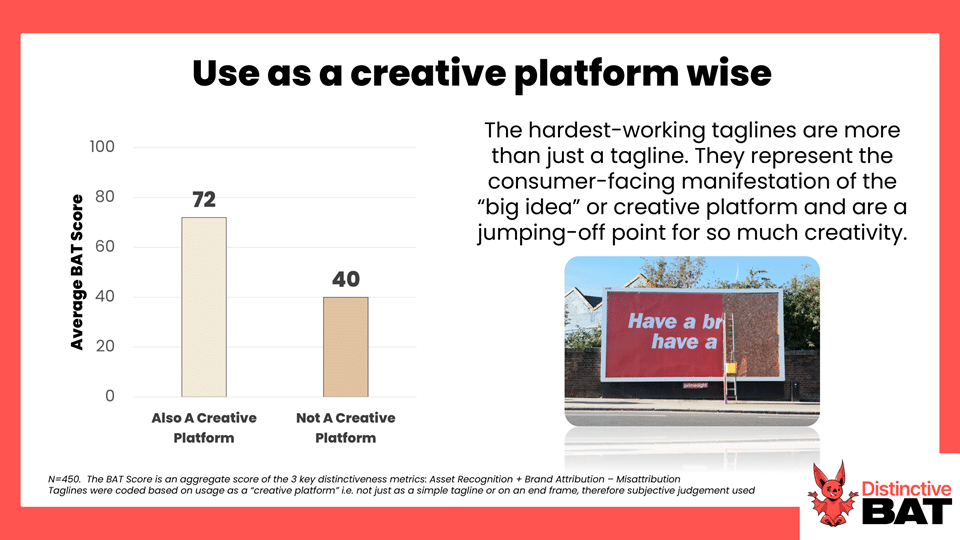
The hardest-working taglines are more than just a tagline. They represent the consumer-facing manifestation of the “big idea” or creative platform and serve as a jumping-off point for a wealth of creativity. This is something we have seen time and time again within client research, and it plays out significantly within the meta-analysis. Often, taglines are not creatively applied and are used only as a sign-off for a 30-second advertisement. It’s naive to think this will be enough. The hardest-working taglines are more than just a tagline. KitKat is an example of a brand that consistently uses a tagline, but they have also made it the hero of their advertising and a central tenet of their creative. This platform provides the perfect amount of focus and direction for creatives to do brilliant work developing top-notch advertising.
Note: Taglines were coded based on usage as a “creative platform” i.e. not just as a simple tagline or on an end frame, therefore subjective judgement used. Some taglines were removed from the analysis as it was not completely clear where to place them.

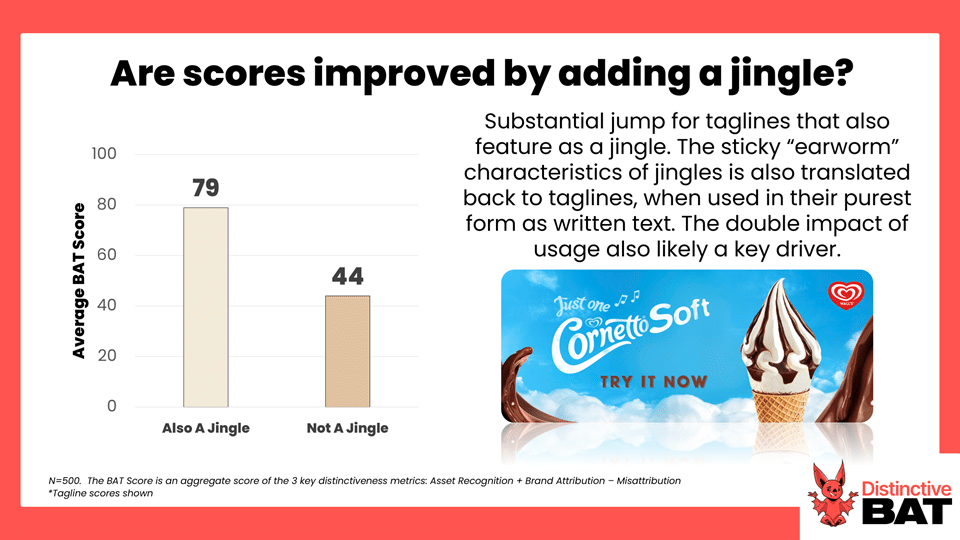
We see a substantial jump for taglines that also featured as a jingle. The sticky “earworm” characteristics of jingles also translate back to taglines when used in their purest form as written text. The double impact of usage is also likely a key driver. Any time we see a golden thread through different types of distinctive assets, we see significant improvements all round (e.g. how a pyramid shape runs through most of Toblerone’s distinctive assets). The use of an additional asset type undoubtedly helps embed the other.
Jingles are very much underutilised in modern times and could be said to be a microcosm of marketing, an incredibly hard-working device that has gone out of favour, for trendier concepts. If looking to lean on a tagline as a DBA, make sure you tease out the possibility in also using it as a jingle.
Note: Scores shown are the tagline version tested.
We also see a small to moderate jump for the more abstract taglines of the world, i.e. those that require slightly more comprehension, suggesting it helps the tagline stand out (Think Heineken “Open Your World” versus say “Superior Light Beer” from Michelob ULTRA).
This supports the old advertising saying related to leaving some of the thinking to consumers, “when baiting the mousetrap, always leave room for the cheese". This intuitively makes sense, that moment of extra cognitive effort helps cement the tagline that bit more in our brains.

We also see some slightly higher uplifts for more emotive taglines, those that are more humorous, playful, or nostalgic in nature. We would have thought the uplifts here would be higher for the more “emotional” type of taglines, so this result was a surprise. We generally see the functional taglines play more of a role as category shortcuts or indeed more related to positioning or even Category Entry Points, versus playing a role in the distinctiveness stakes.

One of the biggest reasons brands struggle to embed a tagline is the lack of airtime and longevity. Many taglines last only as long as a brand campaign related to the latest positioning objective or brand challenge (which is also fine). With all this chopping and changing, it’s no wonder they struggle to become embedded. Perhaps unsurprisingly, the longer the tagline has been live, in general, the higher the scores. Repetition is a huge factor in embedding any asset, and the longer a tagline is live, the higher the frequency it will have over the long term. Survivorship bias also likely at play, with more “successful” taglines standing the test of time.
One would expect a fairly straight upward curve here, but we see a decline for those that were launched 6-10 years ago. While this could very easily be just a blip in the data, the only explanation that comes to mind (and is a bit of a hot take to tell you the truth), is that this period was close to the peak era of marketing ineffectiveness. It was the period just after we got caught up in being too tactical & short-term focused, as well as all the BS of hyper-personalisation, overt purpose focus etc., which has been corrected in more recent years thanks to Ritson, Sharp, Romaniuk, Binet & Field et al.
Note: This was a difficult one to code up due to mixed view points & data online and was predominantly derived from ChatGPT queries. Take from that what you will.

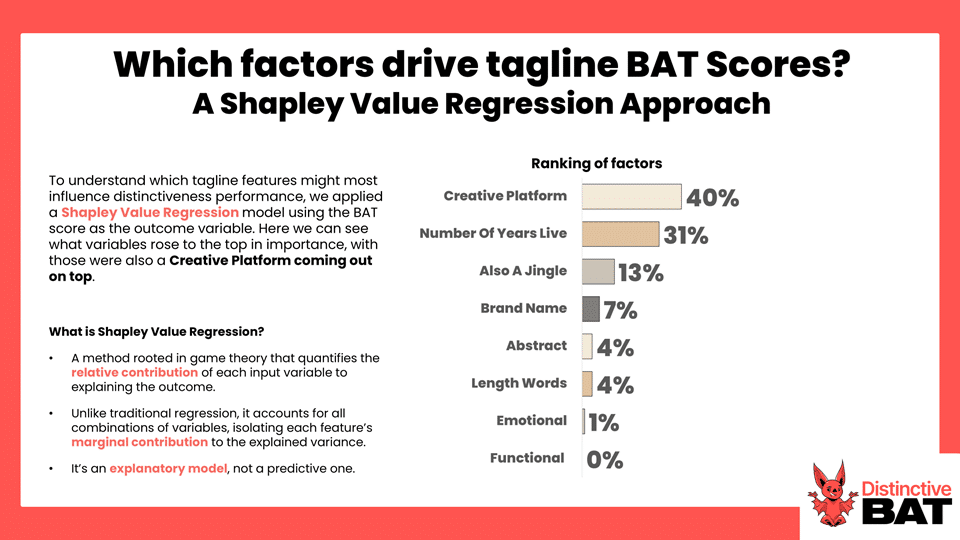
With all that being said, we also wanted to do some further analysis on the ranking of factors that drive tagline distinctiveness scores. To understand which tagline features might most influence distinctiveness performance, we applied a Shapley Value Regression model using the BAT score as the outcome variable. Here we can see what variables rose to the top in importance, with use as a Creative Platform coming out on top.
This wasn’t a surprise at all and cements the need to think bigger than just a signoff tagline, and use it as the totem pole for creative. Easier said than done, of course, but it can be so powerful when done right.
For help on understanding the equity in your taglines or indeed your general suite of brands assets, get in touch for a chat.