When discussing distinctive asset performance, it is often overlooked as to what is actually driving that success. Which variables matter most? What is the individual contribution of each? And what isn't contributing at all?
These questions are particularly relevant to assets such as packaging and advertising style, as well as to individual elements such as icons and logos. Unpacking the specific role of colour, the importance of shape, or how much heavy lifting an icon is doing can be incredibly powerful when planning for distinctiveness.
We answer this brief for clients through a mix of Recessive Isolation and regression modelling, helping us determine the contribution, and therefore importance, of individual assets (variables). First, we break down the variables of interest and create multiple versions of an individual asset. Taking packaging as an example, we isolate specific elements and systematically test numerous pack variations by adding or removing certain features. We then apply these to our distinctiveness research, evaluating them against key metrics, and run Shapley regression modelling to isolate the exact importance weight of each asset.

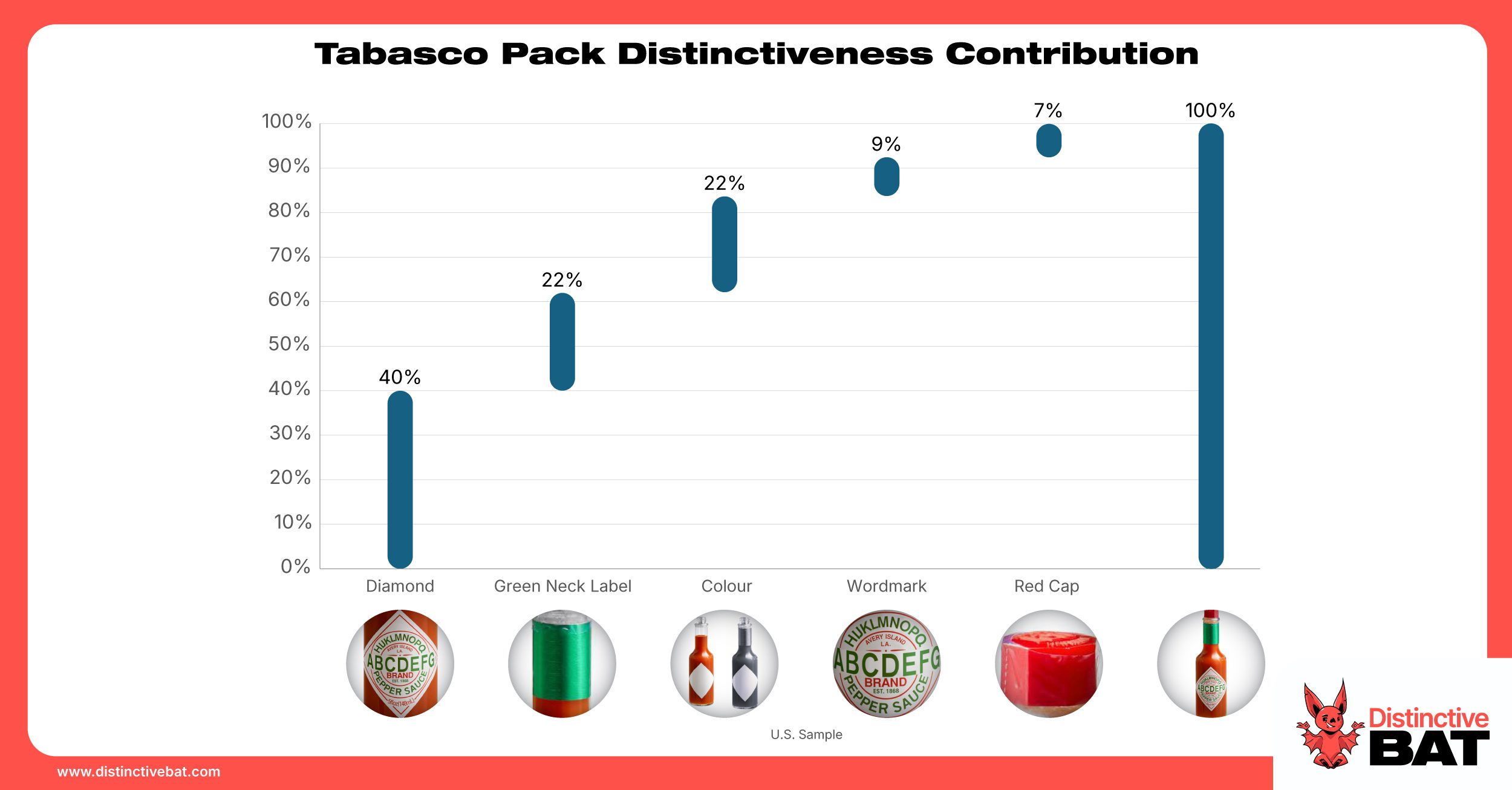
One of the most common insights we uncover is how multiple assets work together to build distinctiveness. This is especially relevant to packaging, where the sum of the parts often drives performance (and makes a pack in totality a DBA). Take Tabasco, for example. The brand has five main variables contributing to its packaging distinctiveness, but our modelling reveals just three real drivers: the diamond label, the bottle's colour, and the green neck sleeve. While it’s clear the diamond label is the ultimate hero asset, this kind of data is also invaluable for informing future range extensions and portfolio design, and how other assets can or should be used (or not!).

Given the clear equity of the diamond label and green neck sleeve, along with support from the wordmark and red cap, the brand has the exact asset hierarchy it needs to establish a consistent design system across its range, particularly its core SKUs. This data also provides the clarity needed to guide range extensions into adjacent categories, where the brand must adapt to new category codes and functional cues. For example, when stretching into spaces like Sriracha, Tabasco still brings multiple core assets into play, namely the diamond, colour, and the wordmark, ensuring the product remains undeniably Tabasco. (Personally, I would have loved to see them bring the green neck label along for the ride!)
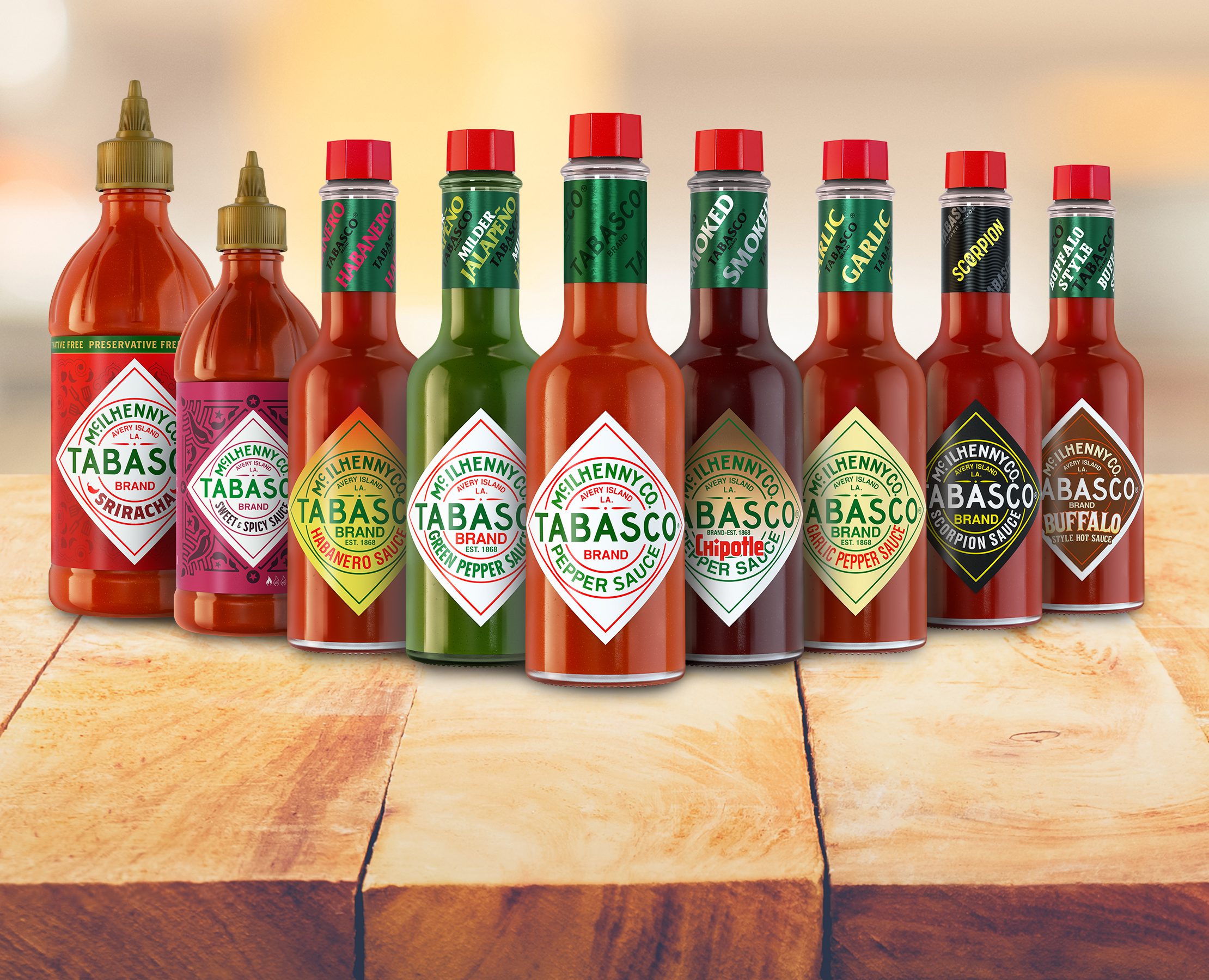
Source: Brand website
For other brands, however, there is often one clear hero driving distinctiveness, such as the Mr Clean character for the famous household cleaning brand. This approach to Recessive Isolation helps triangulate the results in DBA measurement. By pairing this data point with testing assets in isolation, we gain a much truer understanding of a mascot's actual strength. Here, the regression analysis reveals that the character alone accounts for 70% of the packaging's distinctiveness.

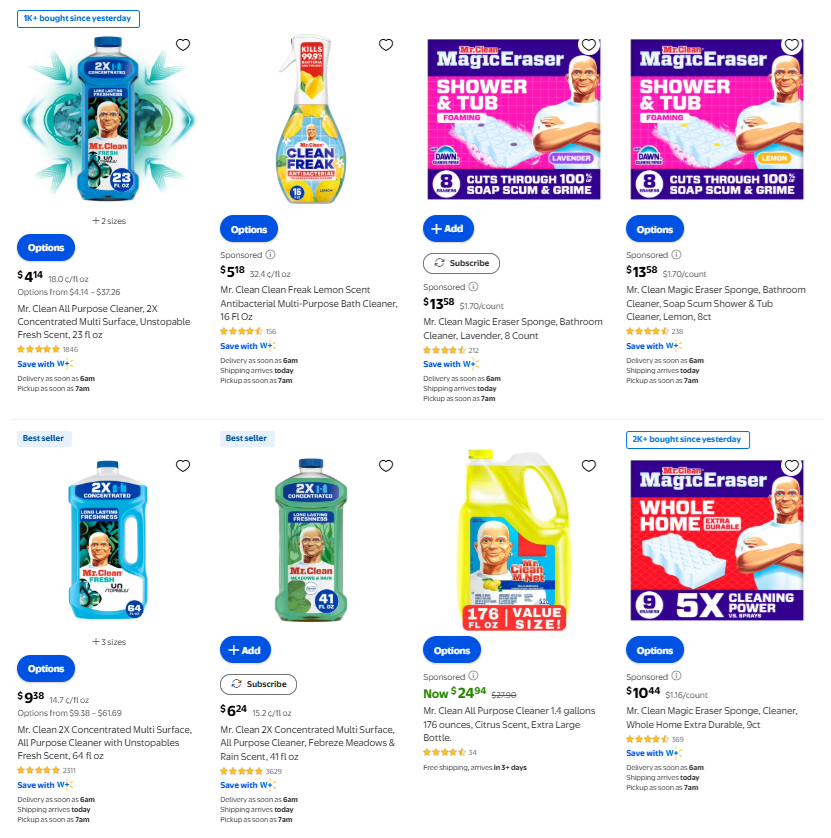
Looking ahead, this analysis clearly dictates what should take the lead of the brand across the wider portfolio, which is obviously Mr Clean. Equally important, it reveals exactly where the brand can tweak individual SKUs to improve on-shelf category navigation. For example, the brand doesn't need to worry too much about shifting away from its core blue colour when introducing new scents or entering adjacent categories. Once Mr Clean is front and centre, that is pretty much enough.
This type of research also helps test assets in context. One of the challenges of standard DBA research, which often draws criticism, is that testing assets in isolation ignores how distinctive assets show up in the real world. Take Smirnoff, for example. While their red logo lockup scores admirably on its own, testing it in context on the bottle reveals its true importance, driving over 55% of the distinctiveness contribution. Furthermore, with another 17% driven by the colour red, and the lockup being the main source of that colour, its overall importance jumps well past 70%.

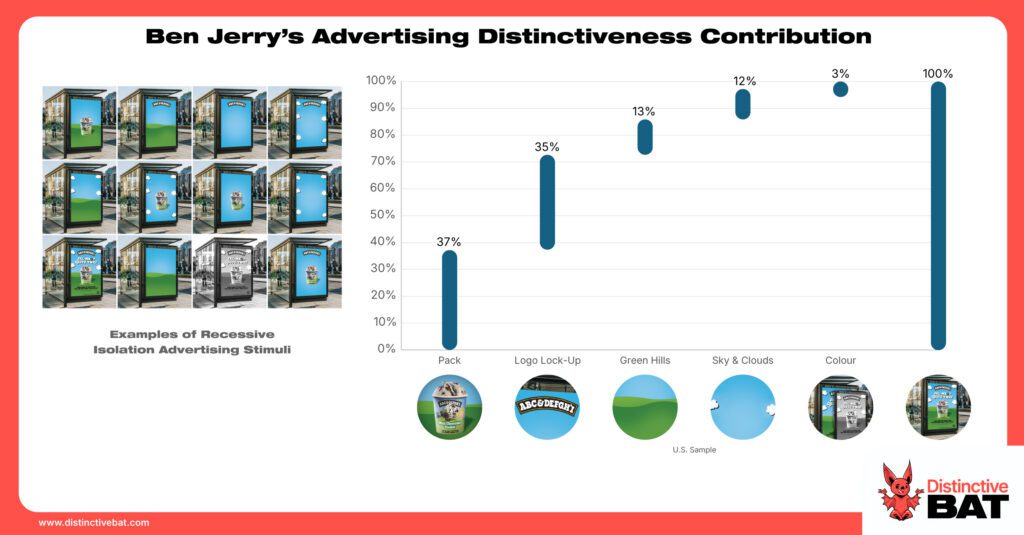
The performance of assets in context is equally critical for communications, especially when evaluating overarching advertising styles. For example, the scores below for Ben and Jerry’s illustrate the asset hierarchy in a typical advertisement. With the pack acting as a key performance driver, it underscores the need to ensure packaging is central to all creative execution, alongside the logo lockup.
Data like this provides the objective clarity brands need to define exactly how they should appear on shelf and in advertising. Innovation plays a vital role in meeting new consumer tastes and occasions, making it a constant requirement for many FMCG brands. Beyond satisfying new needs, expanding a portfolio helps increase overall shelf presence by offering a wider range of products. However, this means your range architecture and design system become critical considerations in how the brand flexes between SKUs. So often, innovation teams operate in a silo from the core marketing department. Without clear guardrails for how a new product comes to market, brands frequently end up with a visually disparate range of SKUs over time.
Twinings is a textbook example of this exact challenge. Over time, a rapid succession of disparate flavours was launched, resulting in a fractured and inconsistent portfolio. The brand resolved this through a major range refresh, consolidating the design system to ensure absolute clarity on the connecting distinctive assets used across every single pack. The logo lockup was given much more breathing room, and a consistent roundel device was introduced as the key visual anchor that connects the entire range.

Image Source: Butterfly Cannon via Packaging Of The World
Ultimately, evaluating assets both in isolation and within context is vital for pinpointing your true drivers of distinctiveness. This dual approach provides the objective clarity required to build a cohesive design system, guiding everything from packaging across the range to broader communication touchpoints.
For help understanding the drivers of distinctiveness for your pack, your advertising, or even a specific DBA, get in touch for a chat.