While the New York Knicks and San Antonio Spurs are battling for NBA Finals supremacy, it’s a different set of teams emerging as the NBA’s most distinctive brands.
Earlier this year at Distinctive BAT, we surveyed 1,600 U.S. sports fans to identify the most distinctive NFL franchises. Now we’re back to assess how NBA franchises stack up! The study tested debranded logos and jerseys to see not only which were most recognizable, but also which were most strongly attributed back to the correct franchise. It also accounted for misattribution, where assets were linked to the wrong team. Results were analyzed using the BAT Score, an aggregate measure combining Asset Recognition plus Brand Attribution, minus Misattribution.
Four teams sit in the top five for both logo and jersey distinctiveness - the Chicago Bulls, Los Angeles Lakers, Boston Celtics and Golden State Warriors. These teams don’t just rely on standout individual design cues; they’ve built complementary visual systems that have compounded over time and offer a blueprint for building enduring distinctive brand assets.
One of the clearest findings was the relationship between success and distinctiveness. The NBA’s most historically victorious franchises – the Boston Celtics (18 championships), Los Angeles Lakers (17), Golden State Warriors (7) and Chicago Bulls (6) – consistently rank at the top for jersey and logo recognition. This doesn’t necessarily mean they have better aesthetically designed assets, rather that decades of play-off exposure, iconic players, merchandising and cultural relevance have reinforced these assets over time. The same pattern appears in commercial branding – iconic assets like McDonald’s Golden Arches and the Nike Swoosh became distinctive because each brand consistently backed them with sustained media investment, ensuring audiences encountered them repeatedly over many years.
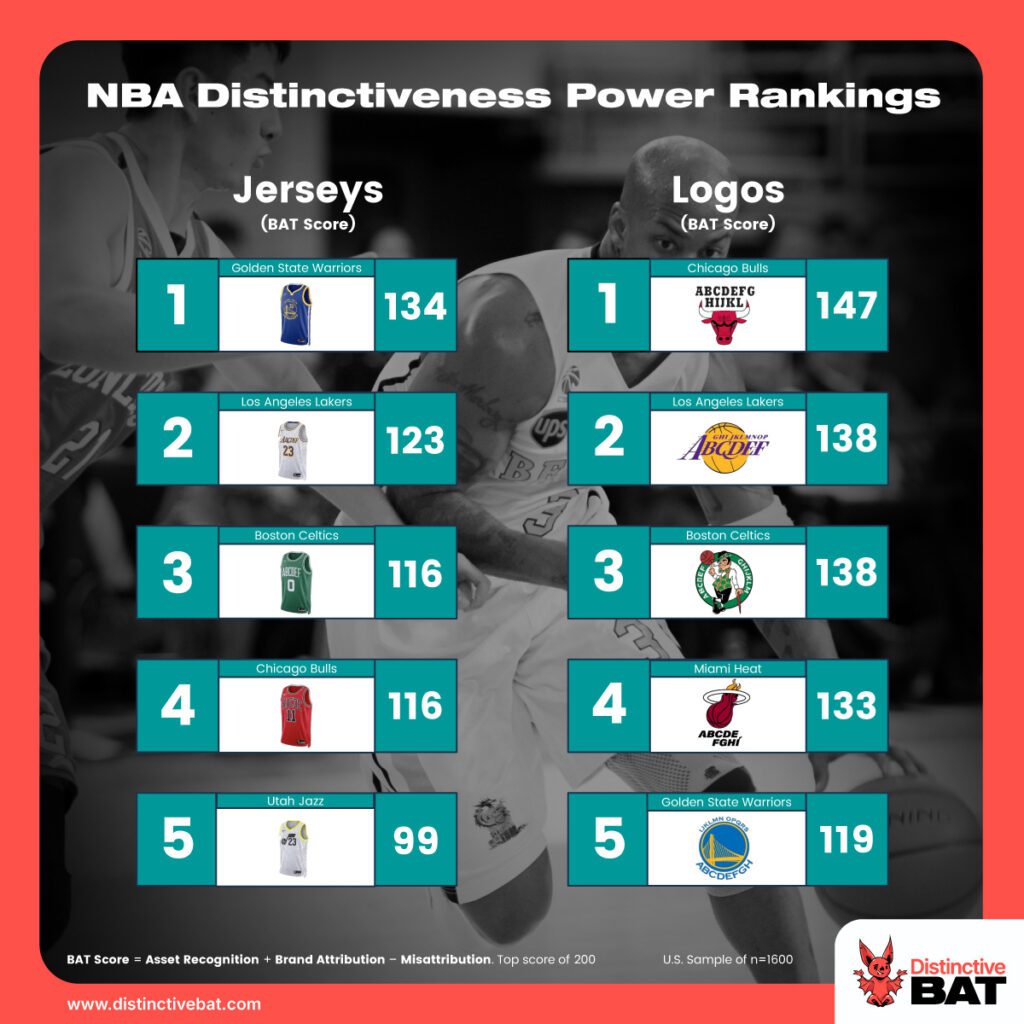
The research also indicates that color plays a powerful role in jersey distinctiveness. Teams with highly ownable color combinations performed among the best, namely the Lakers (purple, white & gold), Celtics (green & white) and Phoenix Suns (purple & orange). On the other hand, many teams sharing similar colour palettes (principally black, navy and red) appeared more vulnerable to confusion and misattribution.
Owning a color isn’t easy; they need to be unique enough and leveraged relentlessly over decades. However, some of the world’s strongest brands - such as DHL (yellow), Tiffany (blue) and Cadbury’s (purple) - achieve this feat, helping them stand out in crowded categories.
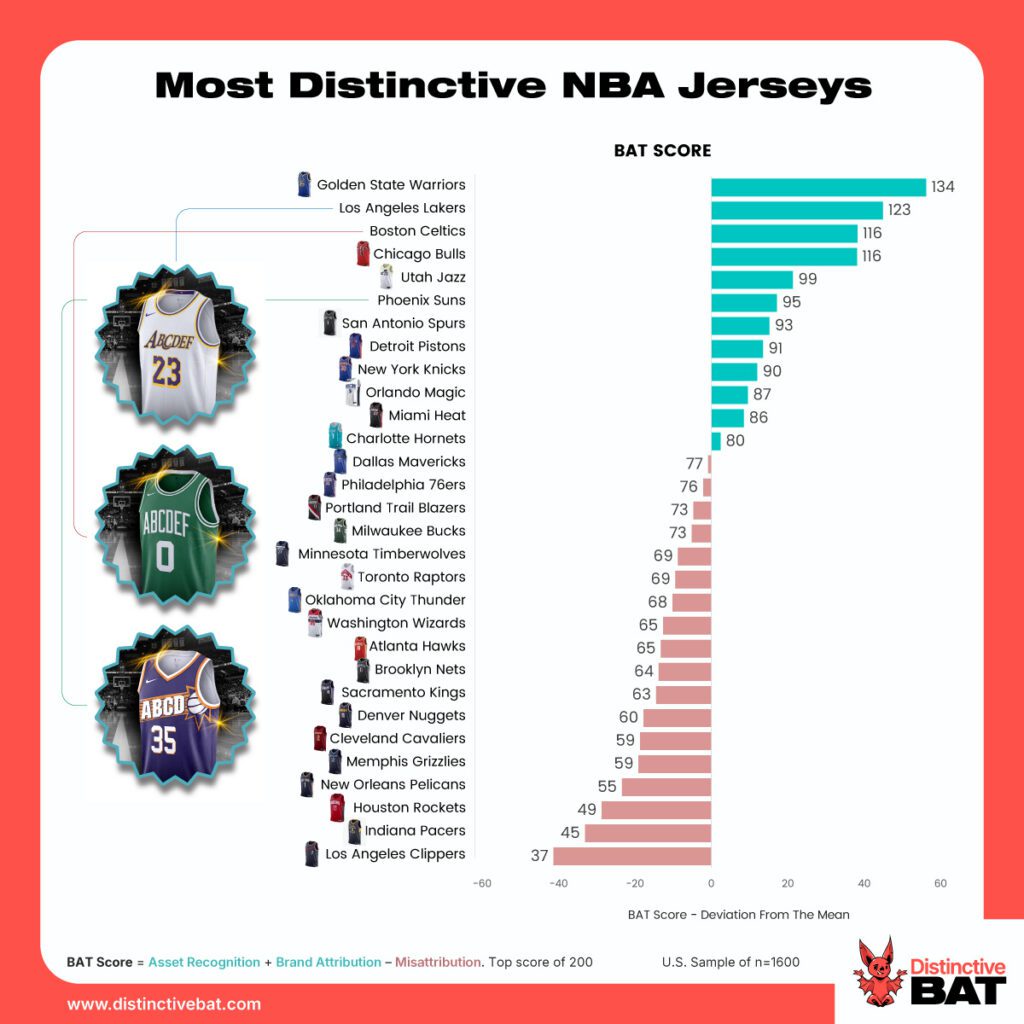
Another clear pattern is the advantage of stable visual identities. The most distinctive teams have treated their branding like sacred ground, with only very subtle refinements over decades. They significantly outperform teams that have regularly refreshed or reinvented their look, such as the Atlanta Hawks, Sacramento Kings and Brooklyn Nets. It’s no surprise to see the Clippers logo rank bottom as this has been through many different iterations in the last few decades, with the latest 2024 creation adopting a completely new (nautical) theme.
The lesson is straightforward but powerful: repetition builds recognition. When visual assets stay consistent over time, each exposure reinforces the same memory structures, making them easier to recognise and correctly attribute. Frequent redesigns disrupt this process.
This matters because many modern brands redesign too often in the pursuit of freshness, simplification or short-term visual trends – especially their logo. Brands like Coca-Cola and Guinness show the alternative approach: gradual evolution, not reinvention, with core assets preserved over decades.
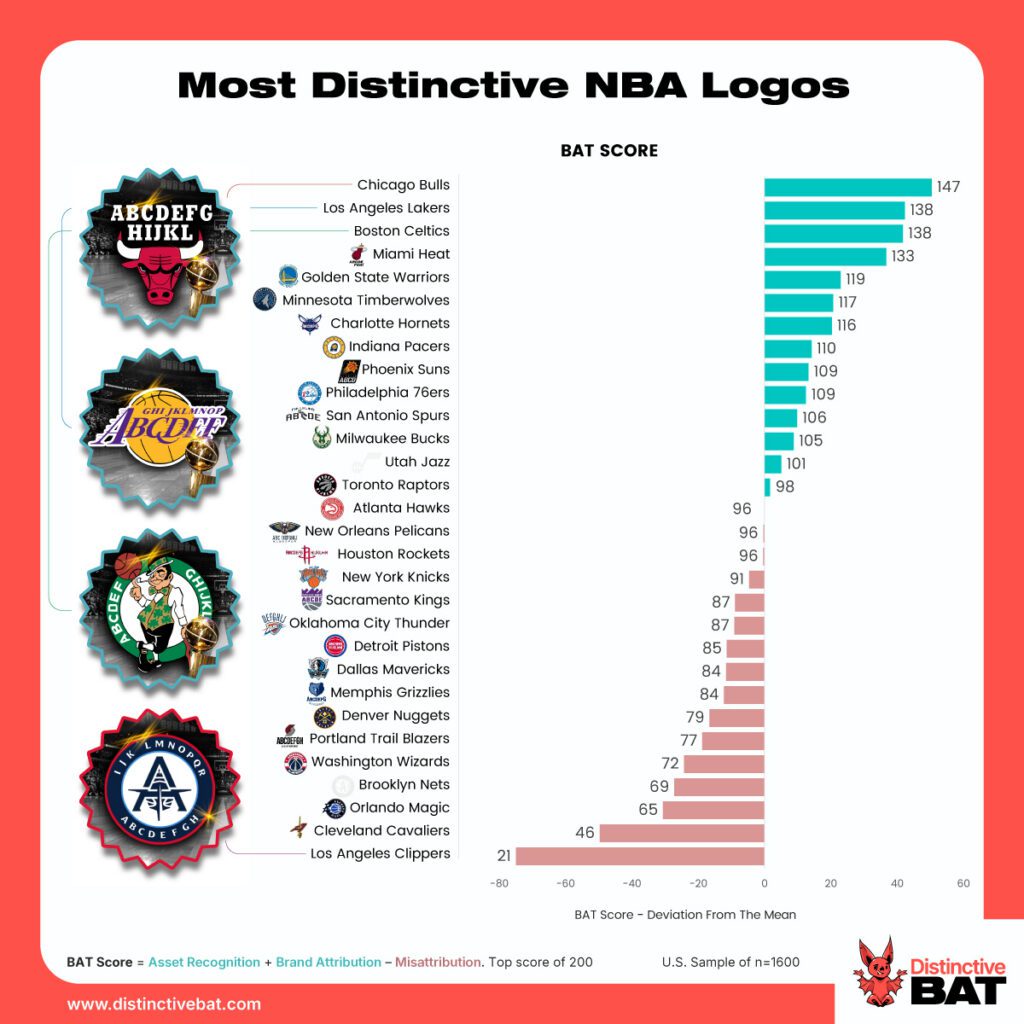
We can identify what makes logos distinctive by breaking them down into their component parts and testing different variants. Looking at the Boston Celtics logo, the ‘Lucky’ leprechaun character is fairly distinctive, even in his simplest form. The addition of a generic category cue in the form of a basketball (which features in most logos) had no measurable impact on distinctiveness. By contrast, the shamrock – present in the Celtics identity since their founding and widely used outside of the logo – significantly increased performance. This reinforces that distinctiveness is driven less by category signalling, and more by the presence of a highly ownable symbolic motif (inherently tied to the logo character) which is consistently reinforced within the identity system.

For consumer brands, the lesson from the NBA’s most distinctive franchises is simple: strong branding isn’t built through constant change, but through disciplined consistency and repeated exposure over time.
If you enjoyed this article, check out our work on the most distinctive NFL franchises!